
Macular Degeneration Assessment & Care
Your central vision plays an important role in everyday activities, from reading and recognizing faces to driving and enjoying the world around you. At Coquitlam Centre Eye Care, we provide comprehensive eye examinations, advanced diagnostic testing, and ongoing monitoring to help identify and manage changes associated with macular degeneration.
What is Macular Degeneration?
What is Macular Degeneration?
Macular degeneration is an eye condition that affects the macula, the small central portion of the retina responsible for sharp, detailed vision. The macula allows us to perform everyday tasks such as reading, recognizing faces, and seeing fine details.
The most common form is age-related macular degeneration (AMD), which primarily affects older adults. As the condition progresses, it can cause blurred, distorted, or missing areas in the centre of your vision.
Unlike some other eye conditions, macular degeneration primarily affects central vision rather than peripheral vision. While advanced cases can significantly interfere with daily activities, AMD does not typically cause complete blindness because side vision is often preserved.
Macular degeneration can develop gradually or, in some cases, progress more rapidly. Early identification and appropriate monitoring are important for understanding the condition and determining whether further treatment or specialist care is needed.
At Coquitlam Centre Eye Care, our doctors can assess retinal health, investigate changes in central vision, and help patients understand their eye care options.

recognizing vision changes
Signs of Macular Degeneration
Macular degeneration does not always cause noticeable symptoms in its early stages. As changes develop within the macula, patients may begin experiencing difficulties with tasks that require clear central vision.
Blurred Central Vision
Objects directly in front of you may appear blurry or less detailed, even when your peripheral vision remains relatively clear.
Distorted or Wavy Lines
Straight lines, such as door frames, window edges, or lines of text, may appear bent or wavy.
Difficulty Reading or Recognizing Faces
Activities requiring fine detail may become increasingly challenging as central vision changes.
Reduced Contrast or Colour Perception
Colours may appear less vivid, and distinguishing objects from their backgrounds may become more difficult.
A Closer Look At Your Retinal Health
Macular degeneration affects structures at the back of the eye that cannot be adequately assessed through a standard vision chart alone. A comprehensive retinal examination allows your optometrist to investigate changes in the macula and determine whether additional diagnostic testing is needed.
At Coquitlam Centre Eye Care, our doctors use advanced diagnostic technology, including Optical Coherence Tomography (OCT), to obtain detailed information about retinal structures and help monitor changes over time.
These assessments are particularly important for patients with known macular degeneration, a family history of the condition, or symptoms that may indicate changes in central vision.
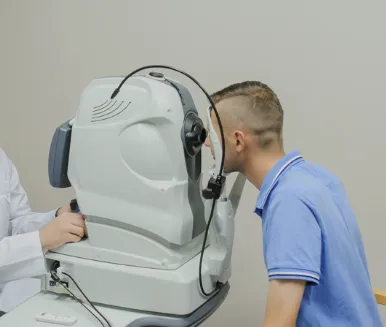
OCT Imaging
Optical Coherence Tomography (OCT) is a non-invasive imaging technique that uses light to create detailed cross-sectional images of the retina.
These images allow your optometrist to examine the layers of the retina and identify structural changes that may be associated with macular degeneration.
OCT imaging can also help establish a baseline for future comparisons, making it easier to monitor changes and determine when additional evaluation or specialist care may be appropriate.
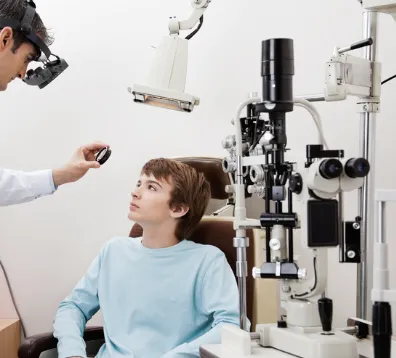
Dilated Retinal Examination
Depending on your individual needs, your optometrist may recommend dilating your pupils to obtain a clearer view of the retina and macula.
This examination can help identify changes such as drusen, pigment abnormalities, or other findings that may require monitoring.
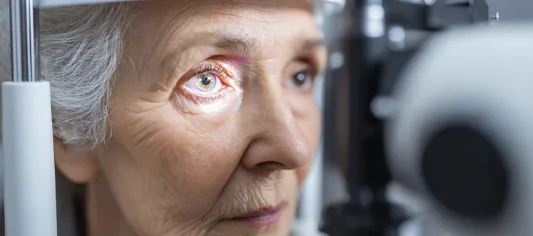
Central Vision Assessment
Your optometrist may assess central visual function using a variety of techniques, including visual acuity testing and an Amsler grid.
An Amsler grid is a pattern of straight lines that can help reveal distortions or missing areas in central vision. It may also be recommended for home monitoring in certain patients.

Managing Macular Degeneration Through Early Detection and Ongoing Care
Although there is currently no cure for age-related macular degeneration, appropriate monitoring, lifestyle measures, and available treatments can help reduce the risk of progression or preserve vision in certain patients.
The recommended approach depends on the type and stage of macular degeneration, as well as the patient's overall eye health.
For patients with dry AMD, management often focuses on monitoring retinal changes, addressing modifiable risk factors, and determining whether specific nutritional supplements may be beneficial.
Certain patients with intermediate AMD or advanced AMD in one eye may benefit from AREDS2-formula supplements. However, these supplements are not appropriate for everyone and should only be considered following an eye-care professional's recommendation.
For patients with wet AMD, treatment typically involves specialized care from an ophthalmologist or retinal specialist. Anti-VEGF injections are commonly used to reduce abnormal blood vessel activity and help preserve vision.
At Coquitlam Centre Eye Care, our doctors can provide comprehensive eye health assessments, monitor changes, and coordinate referrals to specialized ophthalmology departments when additional treatment is necessary.
Supporting Your Long-Term Eye Health
While not every risk factor can be controlled, certain lifestyle choices may support overall eye health.
- Avoid smoking and seek support to quit if needed.
- Maintain a balanced diet that includes leafy green vegetables and other nutrient-rich foods.
- Manage conditions such as high blood pressure and cardiovascular disease.
- Attend recommended eye examinations and follow-up appointments.
- Report new or sudden changes in central vision promptly.
Take an Active Role in Protecting Your Vision
Changes in your central vision shouldn't be ignored. Whether you're experiencing new symptoms, have a family history of macular degeneration, or need ongoing retinal monitoring, our team can help assess your eye health and recommend appropriate next steps.
Prefer to call? (604) 468-8600
Open 7 days a week at Coquitlam Centre
Find Us
Coquitlam Centre Eye Care
2929 Barnet Hwy
Unit 2500, Coquitlam, BC.
V3B 5R5
Phone: 604-468-8600
© 2026 | Coquitlam Centre Eye Care | All Rights Reserved.